
Volum at BDTS 2025
Holographic Virtual Tourism Meets Smart Cities
11/7/20252 min read

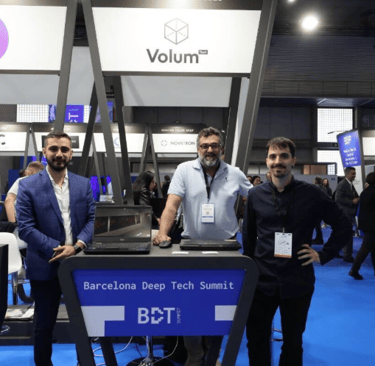
In November, our team joined the Barcelona Deep Tech Summit (BDTS), hosted within the Smart City Expo World Congress (SCEWC) at Fira Barcelona Gran Via. It was the perfect place to share a vision we care deeply about: cities can be experienced, understood, and co-designed together, even when people are far apart.
What we showcased
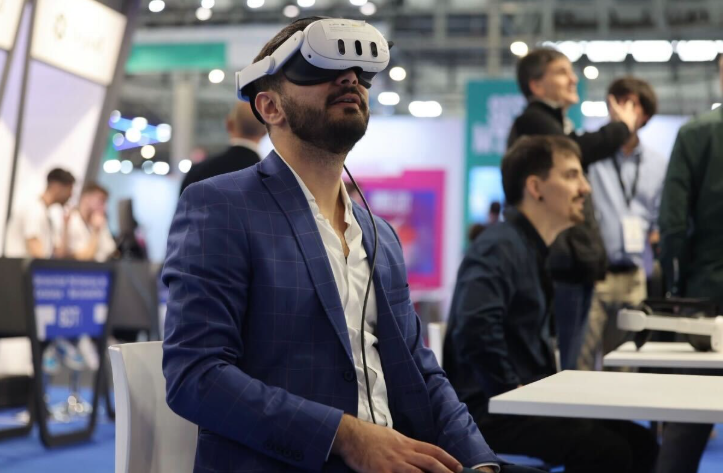
At BDTS, we demonstrated an early version of our Virtual Tourism experience: a multi-user immersive visit where people can meet holographically inside a virtual space and explore a city together. Instead of a one-way 360 video or a passive tour, participants share the same scene, interact in real time, and feel present with each other.
Core experience in one sentence
"Meet as holograms, step into a city together, and explore it as if you were side-by-side."
Key ingredients
Real-time holographic presence: users appear as volumetric/hologram-like representations to each other, not as flat video windows.
Shared virtual tourism: a guided or free-roam visit through points of interest, with spatial audio and natural conversation.
Collaborative storytelling: the experience can be enhanced with narrative layers (history, facts, local stories) that adapt to the group.
Designed for simple deployment: our goal is to make XR and holographic communication easy to set up, run, and scale.
Why this matters for cities
Smart cities are not only about sensors, data, and infrastructure - they are also about people, culture, and inclusion. Immersive and holographic visits can support city goals in practical ways:
Tourism and culture: remote visitors can discover a city before traveling, or participate in virtual visits when travel is not possible.
Accessibility and inclusion: experiences can be tailored for people with mobility constraints, older adults, and audiences in hospitals or remote locations.
Education: schools and libraries can host shared visits to landmarks and cultural spaces as part of learning activities.
Citizen engagement: the same interaction pattern can extend to urban consultations where stakeholders meet inside a digital twin and discuss changes together.
What we learned at BDTS
BDTS brings together startups, researchers, corporates, investors, and institutions around deep tech innovation. For us, it was a great environment to validate interest in social, multi-user XR experiences that blend presence with meaningful content.
People respond strongly to shared presence: the "being there together" feeling changes how users perceive a virtual visit.
Stakeholders want practical deployments: beyond demos, there is demand for solutions that fit real venues, budgets, and operational constraints.
City-focused use cases resonate: cultural heritage, tourism, education, and public services are clear entry points.
What's next
We are continuing to evolve the Virtual Tourism experience into a flexible platform that can be customized for different cities and institutions. Our priorities include improving realism, scalability, and ease-of-use, while keeping the experience social and human-centered.
New destinations and content modules (points of interest, guided narratives, multilingual layers).
More natural interaction (gestures, spatial UI, multimodal input) to make exploration feel effortless.
Deployment-ready packages for events, museums, and city halls - including lightweight setups that work in constrained spaces.
Want to see it in action?
If you are a city, cultural institution, or innovation partner interested in immersive visits and holographic collaboration, we would love to connect. Reach out through our website contact form to schedule a demo or discuss a pilot.
Holographic Virtual Tourism Meets Smart Cities
From the Barcelona Deep Tech Summit, within Smart City Expo World Congress (Barcelona, 4-6 November 2025)
Follow Us
Experience the future of immersive volumetric experiences.
Support
Legal
info@volum.tech
© 2025-2026. All rights reserved.
+34 695 18 04 18